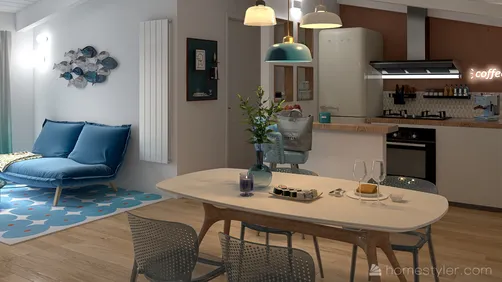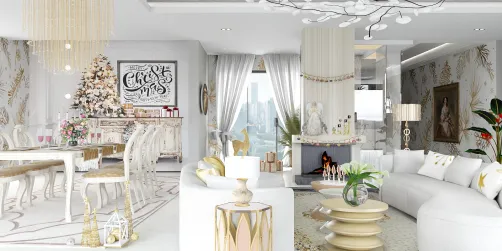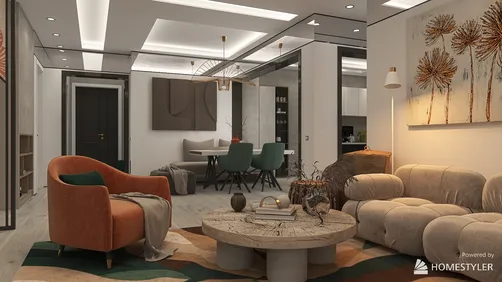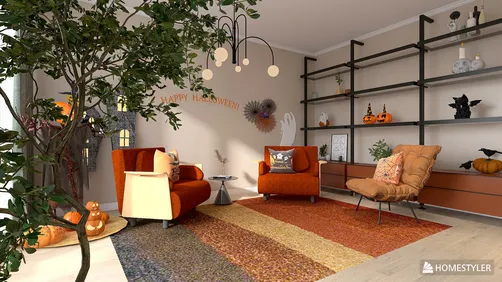
As urban living becomes more refined and intentional, residents find themselves grappling with issues like noise, disorganized storage, and fragmented schedules. Recent industry studies indicate a shift towards smaller living spaces; Zillow reports an ongoing demand for efficient, smaller units in city centers. Amidst this context, the 1 BHK floor plan emerges as an optimal solution for modern living, acting as a blueprint that influences everyday behavior. Utilizing tools like Homestyler allows me to visualize design clarity before the pace of city life accelerates once more.
Linear Spine 1 BHK
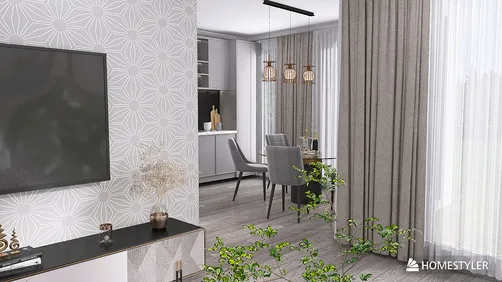
Design Logic: A streamlined corridor connects the entry, kitchen, living space, and bedroom in a linear sequence—minimizing distractions and maximizing spatial efficiency, particularly in compact urban areas where light flow is linear.
Flow: From the entry to a utility niche, transitioning through the galley kitchen, into the living bay, and finally to the sliding door leading to the bedroom; the bathroom is discreetly tucked off the main corridor, decreasing detours and energy loss.
Sightlines: The view from door to window creates a directed focus; partial-height dividers maintain visibility, allowing daylight to serve as an informative visual cue.
Storage: Full-height pantry and built-in wardrobes create efficient storage solutions; with shallow depths to avoid clutter and promote easy access.
Furniture Fit: A sofa measuring 72–78", a 30" café table, and a queen bed with 24" of space on either side; these specifications ensure ergonomic use under space constraints.
Verdict: For single professionals, this arrangement operates like an efficient script—providing seamless mornings, predictable transitions, and a future-proof setup ideal for smart home integrations.
save pin
Courtyard Pocket 1 BHK
Design Logic: A micro-courtyard or lightwell functions as the central processor—room nodes circulate around this open space, harnessing natural light and fresh air as essential resources.
Flow: The entry connects to a circular pathway, with the living and kitchen areas flanking the central void, while the bedroom serves as a buffer; the bathroom occupies a less illuminated corner to enhance natural light optimization.
Sightlines: Perimeter views draw attention towards the courtyard, creating a serene center that minimizes visual disruption and filters out city noise.
Storage: Custom perimeter cabinetry serves as functional storage—incorporating corner units and under-bench bins; modular designs respond dynamically to varying storage needs throughout the year.
Furniture Fit: A compact sectional (64–70"), a mobile dining island (24x48"), and a platform bed with 12" of under-bed storage; each piece is designed to harmonize with the courtyard's airflow.
Verdict: Ideal for couples, this layout maintains privacy while creating a shared focal point; five years later, the lightwell sustains comfortable routines, even when home office demands rise.
save pin
Diagonal Merge 1 BHK
Design Logic: A diagonal layout merges kitchen, dining, and workspace into a cohesive productivity zone—future living trends favor flexible rooms that serve multiple functions.
Flow: The path moves from entry to a coat nook, transitioning through a diagonal dining/workspace and towards the kitchen dock then living bay; the bedroom is positioned slightly off-axis to enhance acoustic privacy.
Sightlines: The diagonal design allows for extended views across shorter distances; design elements stack logically from work areas to relaxation spaces, with windows enhancing transparency at the layout's end.
Storage: Angled wall cabinets, tiered shelving, and headboard niches function as quick-access reserves, prioritizing easy retrieval over extensive storage.
Furniture Fit: A 30x60" surface doubles as a workspace and dining area, with an 18" deep console extending diagonally, and low-profile lounge chairs to maintain clear sightlines.
Verdict: This format enhances efficiency for creatives; it encourages a seamless transition between cooking, working, and leisure, minimizing the need for mental adjustments.
save pin
Final Takeaway: The 1 BHK floor plan serves as a strategic design framework, rather than simply a spatial compromise—its spaces function as interconnected nodes, its access points act as organized pathways, and its storage solutions respond dynamically to life’s demands. Variations such as compact layouts and single-bedroom configurations demonstrate that clarity in design triumphs over size when urban space is at a premium. Ultimately, intentional zoning within a compact 1 BHK unit enhances daily routines more effectively than merely increasing area. My observations suggest that future smart homes will not necessarily be larger but rather more thoughtfully designed, integrating tools like Homestyler for optimal living solutions.
Homestyler is the ultimate online home design platform for anyone looking to transform their space. With its user-friendly design tool, stunning 3D renderings, an extensive library of design projects, and helpful DIY video tutorials, creating your dream home has never been easier!