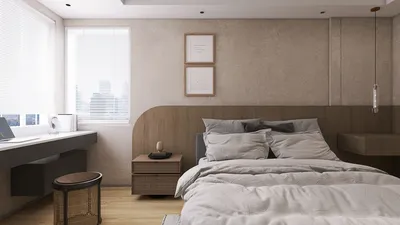
As we look toward the future, every square foot is becoming increasingly significant. The challenge we face is creating compact office spaces that feel human rather than cramped. Recent surveys from the NAHB indicate a rise in smaller office layouts alongside growing expectations for functionality—this creates a delicate balance within a 600 sq ft office plan. I see this layout as an initial operating system for future workspaces, where focus, collaboration, and well-being coexist harmoniously, especially with tools like Homestyler to optimize space usage.
Linear Spine with Modular Bays
Design Logic:
A central circulation spine effectively separates quiet work bays from shared amenities, reflecting the need for flexibility in hybrid work environments. This structure is designed to adapt to varying headcounts and dynamic task assignments.
Flow:
Entry → touchdown bench → spine corridor → focus areas → shared resource wall → informal meeting space → exit; this instruction sequence promotes an efficient movement pattern that reduces cross-traffic.
Sightlines:
An unobstructed view stretches from the entrance to the back wall, featuring partial dividers that offer layered privacy akin to user interface panels—transparent at the core and gradually diffused around the edges.
Storage:
Continuous wall-mounted shelves provide storage solutions, complete with labeled bins and drawers under the desks for quick access, thus maintaining high productivity.
Furniture Fit:
Desks measuring 24–28" deep and modules spanning 48–60" are paired with slim task chairs; adherence to specific dimensions ensures aisles are 36" wide, with 18" buffer zones for additional equipment.
Verdict:
This spine layout scales seamlessly without disturbances, anticipating the rhythm of future hybrid work while maintaining a steady focus.
save pin
Perimeter Ring with Open Core
Design Logic:
Workstations positioned along the perimeter allow for a flexible central core, designed as a collaborative buffer—ready for stand-ups and quick content discussions.
Flow:
Entry → locker area → perimeter workstations → shared core table → materials zone; this flow creates a continuous motion loop, preventing dead ends.
Sightlines:
Low dividers maintain clear sightlines; management can quickly gauge team status at a glance, while peripheral screens help to soften glare and manage visual information density.
Storage:
Utilizing corner towers for bulk storage, floating shelves for active files, and a mobile caddy system ensures efficient load management when teams reconfigure their spaces.
Furniture Fit:
Desks situated at the perimeter are 30" deep, with the central table measuring 72x36", and movable whiteboard panels serve as flexible dividers for temporary rooms.
Verdict:
The perimeter ring organizes focus akin to a dashboard—stable at the edges while allowing adaptability in the center, making it ideal for work that requires frequent iterations.
save pin
Duplex Zones: Quiet Lab + Social Studio
Design Logic:
This layout consists of two distinct areas: a quiet lab designated for deep work and a vibrant social studio for collaborative tasks, embodying the future of asynchronous work.
Flow:
Entry → acoustic pod → dedicated lab → resource bar → social studio → micro-huddle; this setup resembles a branching algorithm that returns to shared resources.
Sightlines:
Translucent panels provide silhouettes without distractions—information remains ambient, similar to notifications that do not disrupt concentration.
Storage:
Strategically placed under-pod storage, overhead rails for equipment, and a labeled bin system near the resource bar ensure data accessibility without clutter.
Furniture Fit:
Compact pods range from 40–48" wide, supported by studio stools and a 30" high counter; maintaining a clearance of 34–36" for pathways facilitates movement and 60" turnaround spaces.
Verdict:
These two zones accommodate diverse mental processes, allowing teams to switch between modes effortlessly—the workspace operates like a smart schedule.
save pin
Final Takeaway
A 600 sq ft office design can function as an efficient operating system: small footprint, maximal intent. In these compact environments, workstations, storage options, and pathways become interfaces that influence workplace behavior. Whether termed a small office design or a hybrid studio, the future emphasizes flow over size. Based on my observations, the most effective workplaces optimize space with tools like Homestyler while enhancing clarity.



Homestyler is an amazing online platform for home design, perfect for both beginners and design enthusiasts. Its user-friendly design tool, stunning 3D renderings, and a variety of informative video tutorials make it easy to visualize and create your dream space effortlessly.














![[For dear Adelina madee 🤎]](https://hs-designs.homestyler.com/production/design/images/8a07e535-9cbc-4132-a42a-5932dac3a112/1706972286037.jpg?x-oss-process=image/resize,w_502,m_mfit/format,webp)