Thai-Style Living Room Design
The Thai-style living room is a serene, culturally rich interior space that harmoniously blends traditional Southeast Asian aesthetics with modern comfort. Drawing inspiration from Thailand’s spiritual heritage and tropical environment, this scene emphasizes natural materials (teak wood, rattan, silk), warm earthy tones (ochre, burnt sienna, forest green), symbolic decor (Buddha statues, lotus motifs), layered textiles, and abundant indoor greenery. Light plays a pivotal role—soft, diffused illumination enhances texture and shadow, reinforcing tranquility. As a core residential hub, the Thai-style living room serves not only as a social gathering area but also as a mindful retreat—making thoughtful indoor space planning essential to balance openness, intimacy, and cultural authenticity.
Design Challenges and Common Pitfalls
Designing an authentic Thai-style living room often faces three recurring challenges: (1) Cultural appropriation vs. respectful homage—overloading sacred symbols (e.g., Buddha statues) without contextual sensitivity risks aesthetic cliché or spiritual insensitivity; (2) Material and color imbalance—excessive gold or ornate carving can overwhelm serenity, while underusing natural textures dilutes authenticity; (3) Spatial misalignment—Thai design thrives on fluid transitions and layered zones (e.g., meditation nook + conversation lounge), yet many designers default to rigid Western furniture layouts, compromising flow and function. These issues underscore why strategic indoor space planning and intentional Homestyler design techniques are vital—not just for visual appeal, but for experiential harmony.
🌿 Prioritize Natural Materials & Organic Texture Layering
Authentic Thai interiors ground luxury in nature—not opulence. Use solid teak, bamboo, handwoven rattan, raw silk, and unglazed ceramics as primary material drivers. Avoid synthetic substitutes; instead, layer textures intentionally: smooth lacquered wood beneath nubby linen cushions, cool stone side tables beside warm jute rugs. This contrast creates tactile depth and honors Thai craftsmanship values. In Homestyler, leverage the 'Material Swap' AI tool to test real-time finishes—e.g., instantly previewing a matte black iron frame versus aged brass on a pendant light—ensuring cohesion before rendering.

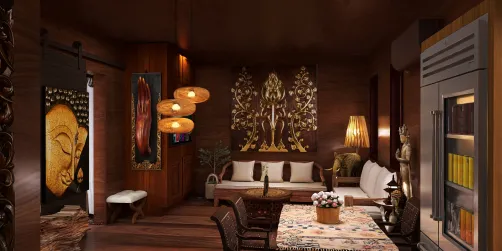
Fani Elvira Ramadhani’s design exemplifies organic texture layering in a Thai-style living room: she pairs a dark teak low-profile sofa with ivory hand-embroidered silk throw pillows and a woven rattan coffee table. Using Homestyler’s AI-driven material library, she precisely matched grain direction and reflectivity across wood elements—achieving visual continuity without monotony. Her indoor space planning deliberately leaves floor space uncluttered, allowing airflow and movement—a subtle nod to Thai spatial philosophy of 'open calm'.
Start Free Design Now🕯️ Curate Light & Shadow as Design Elements
In Thai aesthetics, light is never merely functional—it sculpts mood and meaning. Prioritize layered lighting: ambient (paper lanterns or rice-paper ceiling fixtures), task (brass reading sconces), and accent (spotlights on Buddha niches or wall carvings). Use warm CCT (2700K–3000K) exclusively. Crucially, embrace shadow—not as absence, but as compositional weight. Deep-set windows with wooden louver screens, hanging pendant lights with tapered shades, and recessed alcoves all deepen dimensionality. Homestyler’s real-time 3D rendering lets designers simulate sun-path angles at different times, enabling precise placement of light sources for optimal shadow play.

Leni Franca Designer masterfully uses light-shadow interplay in her Thai-inspired living room: she positions a woven bamboo pendant directly above a low teak platform, casting intricate lattice shadows onto a cream-toned clay-tile floor. Using Homestyler’s lighting simulation, she adjusted fixture height and beam angle until shadows formed gentle, rhythmic patterns—evoking Thai temple latticework. Her indoor space planning ensures no single light source dominates; instead, multiple soft layers create enveloping warmth, ideal for evening relaxation.
Begin Your Free Design🧘♀️ Integrate Sacred Symbolism with Spatial Intentionality
Buddha imagery, lotus motifs, and elephant forms carry deep spiritual significance—thus their placement must be deliberate, not decorative. Reserve elevated, centered, or alcove-protected locations for Buddha statues (never at foot level or in high-traffic zones). Use symmetry and axial alignment to convey reverence; pair symbols with quiet zones (e.g., a cushioned meditation corner near a window garden view). Avoid clustering icons—each should breathe. Homestyler’s ‘Zone Planner’ AI feature helps define functional micro-zones (e.g., 'mindful pause', 'conversation cluster') within one open-plan living room—enabling culturally resonant spatial storytelling.

Sabrinik 💫 integrates sacred symbolism with architectural intention: a small, gilded Buddha sits serenely on a floating teak shelf aligned with the central axis of the room—framed by twin potted areca palms and flanked by recessed wall niches holding ceramic lotus bowls. Using Homestyler’s alignment grid and symmetry tools, she ensured perfect visual hierarchy and spatial reverence. Her indoor space planning avoids placing seating directly facing the statue (per Thai custom), instead orienting the L-shaped sofa at a respectful 45-degree angle—showcasing advanced Homestyler design techniques rooted in cultural awareness.
FAQ
Q: How can I avoid making my Thai-style living room look like a generic 'tropical resort'?
Focus on authenticity over cliché: replace plastic palm fronds with real Areca or Bamboo; choose hand-carved wooden Buddhas over mass-produced resin; use muted, mineral-based pigments (not neon brights) for textiles. Prioritize indoor space planning that reflects Thai lifestyle—low seating, floor cushions, and open circulation paths—not bar-height counters or sectional sofas.
Q: Is it acceptable to use Buddha statues in a non-religious home setting?
Yes—if done respectfully. Place them on elevated, clean surfaces away from foot traffic or cluttered shelves. Never position them in bathrooms, bedrooms, or below waist level. In Homestyler, use the 'Cultural Placement Guide' (under Tools > Design Assist) to validate symbolic positioning before finalizing.
Q: Which Homestyler design techniques best support Thai-style material realism?
Leverage the 'Real-World Material Sync' feature to import PBR textures (roughness, normal, AO maps) from verified Thai artisan suppliers. Use 'AI Texture Match' to auto-generate matching fabric patterns for cushions and curtains based on your selected wood grain. And always render in 'Sun Study Mode' to verify how natural light interacts with layered materials—critical for Thai-style indoor space planning.
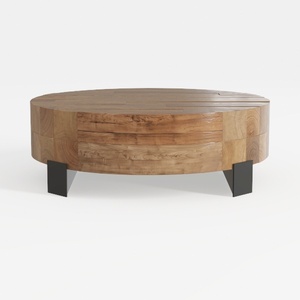

SIMPLIHOME Rayburn Drum Coffee Table - 38 inch

Minimalist Solid Wood Linen Fabric Extra Long Sofa 3D Model

Modern Rattan Solid Wood Linen Upholstered Chaise Lounge 3D Model
Homestyler offers an easy-to-use online design tool with stunning 3D renderings, inspiring interior projects, and helpful DIY video tutorials—perfect for turning your home design ideas into reality effortlessly.
Diseño ahora GRATIS