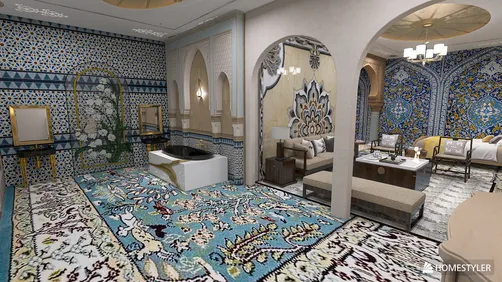
Arabic-Style Living Space Design
The 'Arabic-Style Living Space' refers to a versatile, culturally resonant interior typology—neither limited to residential lounges nor confined to formal reception areas—but rather an experiential zone where heritage motifs meet contemporary spatial logic. Drawing from UAE National Day’s spirit of unity and evolution, this scene synthesizes desert-inspired warmth, Islamic geometric discipline, and modern minimalism. It prioritizes sensory harmony: layered textures (woven rugs, hammered metal, carved wood), strategic light diffusion (through mashrabiya-inspired screens or arched apertures), and chromatic depth (emerald, tangerine, sapphire, and ivory). Crucially, it transcends literal ornamentation—it’s about spatial rhythm, symbolic proportion, and quiet luxury rooted in centuries-old design wisdom.
Design Challenges & Common Pitfalls
Key challenges include balancing ornate tradition with clean modern functionality; avoiding visual overload from excessive pattern layering; achieving authentic cultural resonance without resorting to clichéd ‘Orientalist’ tropes; integrating traditional elements (e.g., horseshoe arches, zellige tiles) into non-Moorish floor plans; and maintaining spatial clarity in compact layouts while honoring the Arabic emphasis on generous circulation and intimate niches (mashrabs). Many designers also underestimate lighting’s role—Arabic interiors rely on nuanced, layered illumination (ambient + accent + task) to animate geometry and texture, not just brightness.
✅ Principle 1: Geometry as Spatial Grammar
Geometric patterns—whether in tilework, plaster reliefs (muqarnas), or ceiling rosettes—are not decorative afterthoughts but structural organizers of space. Use symmetry, radial repetition, and interlocking star-and-polygon motifs to define zones, guide movement, and create visual hierarchy. Scale matters: large-scale floor patterns anchor seating areas, while delicate wall borders frame views and soften transitions. Always align patterns across surfaces (e.g., floor-to-wall continuity at dado height) for perceptual cohesion.

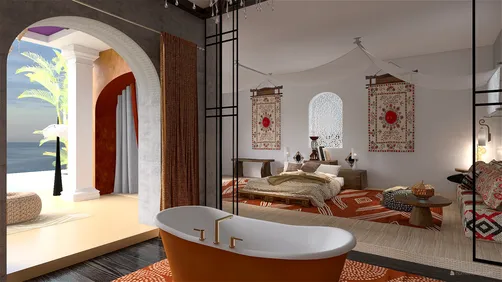
Arch.Motaz Owda’s 'Yemen Style Resturant' demonstrates how geometry anchors function: the kitchen layout uses a precise octagonal tile medallion beneath the central island—echoed subtly in cabinet paneling and ceiling recess—transforming a utilitarian zone into a ritually grounded hub. Using Homestyler AI design tools, he generated custom tile patterns via parametric texture mapping, ensuring seamless alignment across floor, backsplash, and upper cabinetry—showcasing how digital precision elevates traditional spatial grammar within tight indoor space planning constraints.
Start Free Design✨ Principle 2: Light as Material
In Arabic design, light is sculptural—not merely illuminative. Prioritize diffused, directional, and reflected light over harsh direct sources. Integrate layered lighting: ambient (recessed or cove), accent (focused on art or arch details), and task (under-cabinet, reading nooks). Leverage translucency (stained glass, etched acrylic, perforated metal) and shadow play (via latticework or angled reveals) to add depth and temporal dimension. Natural light should be modulated—not blocked—to create shifting patterns that animate static surfaces throughout the day.

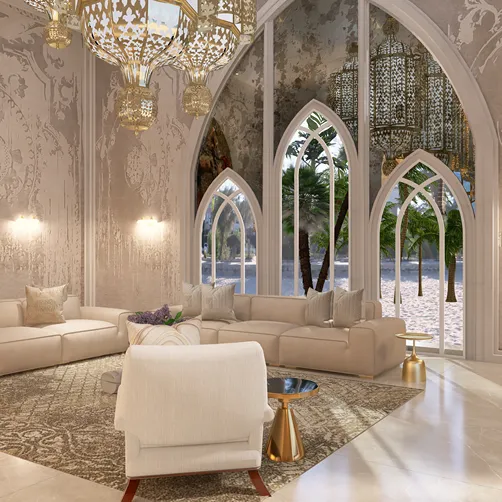
Encarni Fernandez Calero’s 'Bayt Al Ruh – Casa del alma' transforms natural light into narrative: large arched windows cast elongated, rhythmic shadows across hand-troweled plaster walls, while a suspended brass chandelier with laser-cut geometric shades creates dappled floor patterns that evolve hourly. She used Homestyler’s HDR sunlight simulation and real-time material rendering to test dozens of reflectivity values and aperture ratios—proving how advanced Homestyler design techniques enable intuitive indoor space planning that responds dynamically to environmental context.
Begin Your Free Design🌿 Principle 3: Craftsmanship Meets Contemporary Materiality
Authentic Arabic interiors fuse artisanal authenticity with modern performance. Reimagine traditional materials—zellige tile, cedar wood, gypsum plaster—with updated substrates, finishes, and applications: e.g., digitally printed ceramic panels mimicking hand-cut tile; CNC-carved MDF muqarnas modules; or terrazzo infused with crushed turquoise and copper slag. Texture contrast is vital—pair rough-hewn stone with polished nickel, or nubby wool with high-gloss lacquer. Every surface must invite touch and tell a story of making—without compromising durability, sustainability, or maintenance practicality.

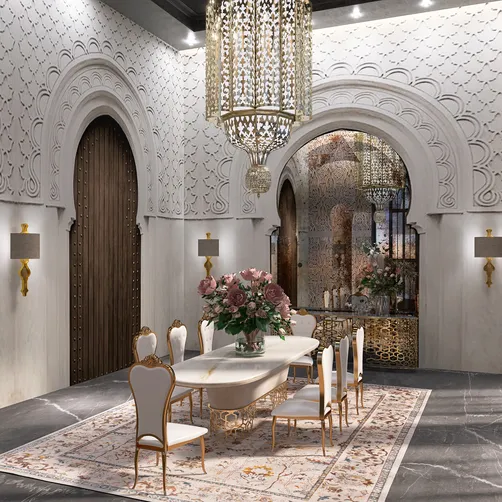
ROBERTA GIULIETTI’s 'Sile Arabo' exemplifies material innovation: her double-height living room features a staircase clad in matte-black steel grating overlaid with backlit, translucent resin panels embedded with gold-leaf geometric fragments—a contemporary reinterpretation of mashrabiya. Using Homestyler’s material library and cross-section preview, she iterated over 12 composite material combinations to achieve the exact balance of opacity, glow, and structural integrity—highlighting how Homestyler design tools empower designers to prototype complex craftsmanship-integrated solutions before physical execution, optimizing indoor space planning efficiency and reducing revision cycles.
FAQ
Q: Do I need prior experience with Arabic architecture to enter the AIDA Arabic-style challenge?
Not at all. The competition celebrates conceptual fusion—not historical replication. Focus on core principles: geometry-driven composition, light-as-texture, and respectful material storytelling. Homestyler’s AI-powered style transfer and pattern generator make authentic motifs accessible even to beginners.
Q: Can I use Homestyler AI to generate Arabic-specific decorative elements like zellige or muqarnas?
Yes— Homestyler’s latest update includes a dedicated ‘Islamic Geometric’ asset pack with scalable, editable tile sets, 3D muqarnas components, and parametric arch generators. All are optimized for accurate scale, lighting interaction, and export-ready rendering—ideal for refining indoor space planning details.
Q: How important is color accuracy when representing Arabic palettes (e.g., emerald, saffron, indigo)?
Critical. These hues carry cultural resonance and affect spatial perception. Use Homestyler’s calibrated PANTONE®-aligned material swatches and real-time daylight simulation to validate chromatic behavior under varied lighting conditions—ensuring your palette enhances, rather than overwhelms, the intended serenity and depth.
Q: Are there restrictions on room types for the 'Arabic-style Space for Web' contest?
No—the brief invites any interior space (living, dining, lounge, boutique, gallery, even transitional zones like stair landings or entry vestibules) as long as it embodies the fusion ethos. Prioritize emotional impact and spatial coherence over programmatic convention—this is where thoughtful indoor space planning meets cultural narrative.

SERWALL Folding Outdoor Side Table Set of 2

Modern Patterned Fabric U Shaped Sectional Sofa 3D Model

Modern Curved Orange Fabric Sectional Sofa 3D Model
Homestyler is a user-friendly online platform that lets you design your home effortlessly. With powerful 3D rendering, a vast collection of interior projects, and helpful DIY video tutorials, it’s perfect for bringing your design ideas to life. Try it and get inspired today!
Diseño ahora GRATIS