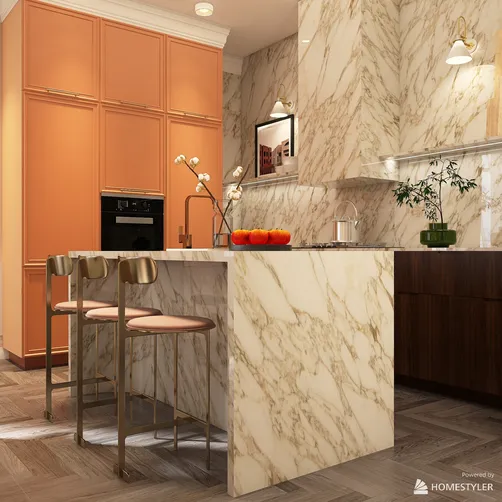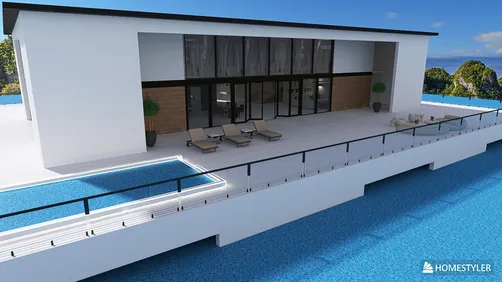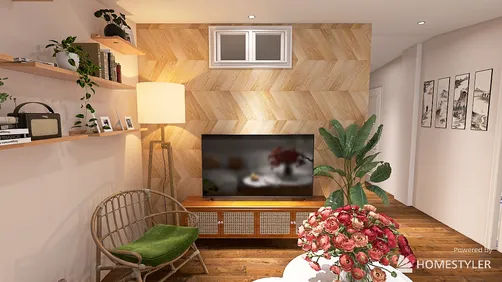
As families navigate the complexities of hybrid work, caregiving responsibilities, and mental overload, the need for innovative home designs has never been more pressing. Current homes often struggle with issues related to circulation and storage. According to AIA, there is a persistent demand for adaptable multi-generational layouts, and I view a four-bedroom, two-story plan as an evolving strategy to address these challenges. The future is on the horizon, and I can already discern its shape in the ways we organize privacy, collaboration, and recovery throughout our living spaces—particularly with tools like Homestyler that aid in visualizing these concepts.
Garden-Level Commons + Upper Private Ring
Design Logic: The design features a commons area on the lower level and a sleeping zone above—similar to a server layer that serves a secure user tier—accommodating multi-generational living and the demands of future remote work.
Flow: From the entry → drop zone → kitchen core → living space → stairs leading to quiet areas; guests remain in the public areas while family members access private paths.
Sightlines: The kitchen sightlines extend to dining and play areas; stairs are designed with controlled views, offering a user interface that presents only what is necessary.
Storage: Features like under-stair cache, pantry walls, and linen banks ensure ample storage near high-traffic areas for quick access.
Furniture Fit: The design allows for a sofa measuring 9–10 feet, dining seating for 8–10 people, and bedrooms that fit queen or king-sized beds without compromising on 36" clearances.
Verdict: This separation of social and private spaces insulates sleep from disturbances, and even five years later, it remains flexible to accommodate changing schedules and caregiving needs.
save pin
Dual Primary Suites + Adaptable Flex Node
Design Logic: Incorporating two primary suites—one situated upstairs and the other downstairs—addresses concerns for aging in place and visits from parents; the flex room can adapt to serve as an office or nursery as needed.
Flow: From the street → buffer foyer → down to suite A → shared core → up the stairs to suite B → the flex room can address changing roles without needing to reroute the entire space.
Sightlines: The primary suite doors are strategically offset; the design allows for visual privacy similar to tiered access—common areas are open while suites provide privacy.
Storage: The dual walk-in closets function as long-term storage; the flex room incorporates a wall system for managing work, hobbies, and school materials.
Furniture Fit: King-sized beds fit with 30–36" perimeters, and desks are designed to be 24" deep; modular lounges can be reconfigured without obstructing flow areas.
Verdict: This design future-proofs family dynamics, allowing households to transition roles effortlessly while maintaining a clear and functional layout.
save pin
Courtyard Spine with Distributed Micro-Workstations
Design Logic: A linear outdoor courtyard serves as both a thermal-light regulator and social buffer; micro-working spaces integrate productivity into home life seamlessly.
Flow: Movement flows from the kitchen to the courtyard slider → around the light well → workstation nooks; breaks are naturally incorporated into the design.
Sightlines: Long axial views promote tranquility, while cross-views are crafted to minimize distractions; children can be observed while focus is maintained.
Storage: Benches at entries provide cache space, a tall utility wall near the laundry enhances storage, and a concealed tech closet keeps routers and printers out of sight.
Furniture Fit: Built-in banquettes stand at 18" height, and the courtyard table is 30" deep for outdoor work; bedrooms are designed to accommodate wardrobes and reading chairs.
Verdict: The design optimally utilizes daylight as a resource, ensuring that the house effectively manages energy throughout different seasons and schedules even after five years.
save pin
Final Takeaway
A four-bedroom, two-story design transcends mere spatial organization; it functions as a dynamic interface that manages noise, caregiving, and focus akin to data routing across various channels. Variants such as layouts featuring dual suites or courtyard designs illustrate how privacy and collaboration are essential factors in shaping the future of domestic spaces. From my perspective, the most intelligent homes moving forward won’t necessarily be larger; rather, they will be extremely purposeful. In my ongoing projects, I find that slight spatial adjustments through tools like Homestyler are redefining how families interact with their environments.


Looking for an easy way to design your dream home? Homestyler offers a user-friendly online design tool, stunning 3D renderings, a variety of design projects, and helpful video tutorials. It's the ideal platform for both beginners and seasoned decorators to create beautiful interiors effortlessly.














![[For dear Adelina madee 🤎]](https://hs-designs.homestyler.com/production/design/images/8a07e535-9cbc-4132-a42a-5932dac3a112/1706972286037.jpg?x-oss-process=image/resize,w_502,m_mfit/format,webp)