


Illusionary Interior Design
Illusionary Interior Design refers to a creative spatial approach that challenges perception through visual tricks, distorted proportions, impossible geometries, and surreal material juxtapositions. Inspired by the 'Design or Deceive? April Fool’s Interiors' contest, this scene transcends conventional functionality — prioritizing experiential surprise, cognitive play, and narrative ambiguity. It’s not about fooling the eye permanently, but inviting occupants to question spatial logic, scale, gravity, and reality itself — turning everyday rooms (living areas, offices, children’s spaces) into immersive, thought-provoking environments where walls tilt, ceilings invert, furniture defies physics, and mirrors multiply dimensionality. This design philosophy leverages interior space planning as a storytelling tool, where Homestyler AI design tools enable rapid prototyping of paradoxical layouts, real-time perspective testing, and seamless integration of optical elements like anamorphic surfaces or forced-perspective flooring.
Design Challenges & Common Pitfalls
Designing illusionary interiors introduces unique complexities: (1) Balancing visual deception with physical safety and usability — e.g., an upside-down desk must remain ergonomic; (2) Avoiding sensory overload — excessive distortion can cause discomfort or disorientation rather than delight; (3) Ensuring technical feasibility — many illusions rely on precise lighting angles, custom millwork, or calibrated rendering that may not translate directly from digital mockup to built reality; (4) Maintaining coherence across zones — a single 'impossible' staircase shouldn’t clash tonally with adjacent functional areas. These challenges demand rigorous interior space planning, iterative testing in 3D, and deep understanding of human visual cognition — all supported by advanced Homestyler design techniques such as AI-powered perspective simulation and real-time material-light interaction previews.
🎯 Rule 1: Prioritize Perceptual Anchors
Every illusionary space needs at least one strong, recognizable reference point — a familiar object, consistent scale cue (e.g., standard-height doorframe), or grounded color tone — to prevent total spatial disorientation. These anchors stabilize perception and make the illusion legible and intentional, not chaotic.

Camay 68’s 'Happy April Fool's Day' applies this principle masterfully in a children’s room: while playful elements like oversized bows and floating pumpkin lamps introduce whimsy, the clearly defined bed, standard-height toy shelf, and realistic cat figurine serve as perceptual anchors. Using Homestyler AI design tools, Camay anchored the composition with consistent daylight rendering and proportional furniture placement — ensuring the illusion feels joyful and safe, not destabilizing.
Start Free Design Now🌀 Rule 2: Leverage Forced Perspective Strategically
Forced perspective manipulates scale and depth using converging lines, graduated object sizing, or tilted planes. When applied intentionally — e.g., narrowing floor tiles toward a wall or angling ceiling beams — it creates convincing illusions of height, distance, or inversion without structural alteration.

slman🎀 Al-Arifi’s cozy children’s bedroom uses subtle forced perspective: the angled headboard, progressively smaller decorative stars on the wall, and carefully aligned shelving create gentle depth — enhancing intimacy without confusion. Homestyler AI design tools enabled precise alignment of vanishing points and instant preview of how lighting interacts with slanted surfaces, making complex perspective adjustments intuitive and accurate.
Create Cozy Magic Free✨ Rule 3: Integrate Illusion with Functionality
The strongest illusionary designs never sacrifice utility. A mirrored ceiling should also provide ambient light; a gravity-defying bookshelf must hold weight; an ‘inverted’ office layout must support ergonomics and workflow. Illusion serves experience — not replaces purpose.

Anna Tallian’s 'Relax Corner' exemplifies functional illusion: the luxurious living room features a dramatically angled ceiling mirror and asymmetrically suspended chandelier — yet the sofa remains deeply comfortable, the coffee table perfectly positioned, and natural light from the window fully preserved. Through Homestyler AI design tools, Anna simulated real-world light bounce and tested seating sightlines before finalizing, proving that illusionary interior design and practical interior space planning coexist seamlessly.
FAQ
Q: Can I create illusionary interiors without professional 3D modeling skills?
Yes — Homestyler AI design tools simplify illusion creation with drag-and-drop perspective widgets, auto-aligning forced-perspective flooring, and real-time mirror/reflection simulators. No coding or CAD expertise is required.
Q: How do I avoid making an illusionary space feel unsettling or unsafe?
Always include perceptual anchors (e.g., a standard door, familiar object scale, consistent horizon line) and test your design under multiple lighting conditions using Homestyler’s sun-path and artificial light preview features.
Q: Are there specific Homestyler model libraries optimized for illusionary design?
Absolutely — the official 'April Fool’s Model Collection' (ID: 669) includes gravity-defying furniture, anamorphic rugs, dual-scale decor, and smart-mirror assets — all tagged and optimized for spatial deception and interior space planning workflows.
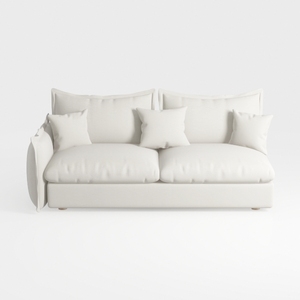
Minimalist White Fabric Loveseat Sofa with Throw Pillows 3D Model


Camaflexi Daybed, Panel Headboard / Solid Wood / F
Homestyler offers an easy-to-use online design tool with stunning 3D renderings, abundant interior projects, and helpful DIY video tutorials. It’s perfect for bringing your home design ideas to life, whether you’re a beginner or a seasoned decorator.
Diseño ahora GRATIS





