Arabic Style Decoded: Tradition Meets Modernity in Interior Design
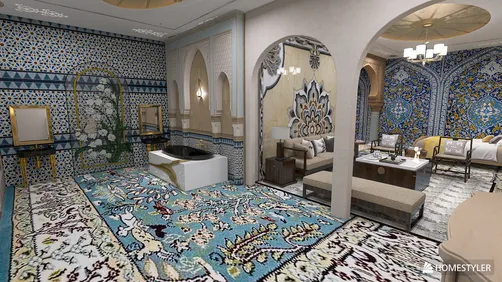
Arabic interior design is not merely a visual motif—it's a living dialogue between millennia-old heritage and forward-thinking aesthetics. Rooted in the vast deserts, ancient trade routes, and cosmopolitan cities of the Arabian Peninsula and North Africa, this style synthesizes Islamic art principles, regional craftsmanship, and contemporary spatial sensibility. At its core lies a reverence for geometry, light, texture, and layered meaning—where every arch, tile, and textile tells a story of continuity and cultural pride. The 2025 Homestyler 'Arabic-style Space for Web' challenge—timed to honor UAE National Day—showcases how designers worldwide reinterpret these traditions using digital tools: blending intricate zellige patterns with minimalist layouts, pairing hand-carved mashrabiya screens with smart-glass partitions, and anchoring opulent color palettes in serene, human-scaled environments.

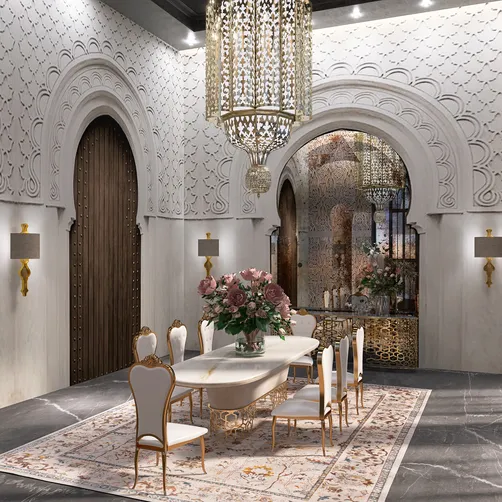
Yemen Style Restaurant by Arch.Motaz Owda — This vibrant kitchen exemplifies Arabic design’s narrative warmth: rich earth-toned cabinetry echoes Yemeni adobe architecture, while brass-finished hardware and arched window framing nod to historic craftsmanship. In Homestyler, users can instantly achieve this look using the built-in 'Arabic Traditional' material pack—applying authentic terracotta textures, custom geometric tile decals, and dynamic daylight simulation (HDR: ljz_day) to render sun-dappled authenticity in under 90 seconds.
Start Free Design Yemen✨ Geometry as Soul: The Language of Symmetry & Pattern
Geometric precision is the heartbeat of Arabic design—not as ornament, but as philosophy. Derived from Islamic prohibitions on figural representation, centuries of artisans developed infinitely repeatable star-and-polygon motifs (8-pointed stars, hexagons, interlaced strapwork) that symbolize divine order and cosmic unity. These patterns appear in zellige tilework, carved plaster (gypsum), metal screens (mashrabiya), and even ceiling medallions—always mathematically rigorous, never random. In modern interpretations, they’re scaled down for minimalist backsplashes or blown up as wall murals, balancing sacred complexity with clean lines.

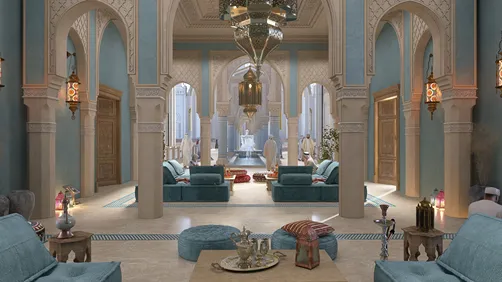
Morocco Blue 1970 House USA by Kristy Gouvea — Here, geometry anchors the entire composition: the cobalt-blue zellige floor forms an 8-pointed star grid, echoed subtly in the ceiling’s recessed lighting layout and the wrought-iron pendant’s radial symmetry. Notice how the pattern doesn’t overwhelm—it breathes alongside neutral walls and organic textiles. In Homestyler, designers use the 'Pattern Overlay' tool with adjustable scale and rotation to auto-align tiles to floor plans, then export seamless 4K renders—no manual tiling required.
Free Design Moroccan Warmth🌙 Archways & Light: Sculpting Space with Curves & Shadow
The arch—whether horseshoe, pointed, multifoil, or Tudor—is far more than decorative. It’s a structural and spiritual device: softening transitions between rooms, guiding movement, and modulating light. Traditional Arabic interiors choreograph light through layered apertures—deep-set windows, latticed screens, domed skylights—creating ever-shifting shadows that animate static surfaces. This interplay fosters serenity and introspection, turning architecture into a time-based experience. Today, designers reinterpret arches as bold wall cutouts, curved drywall dividers, or floating shelf systems—honoring rhythm without replicating historic masonry.

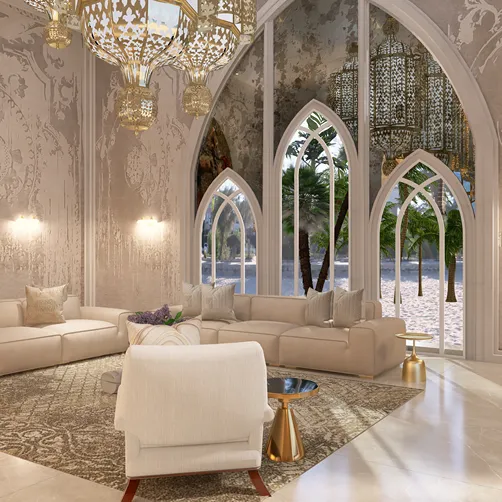
Sile Arabo by ROBERTA GIULIETTI — A masterclass in vertical light choreography: the double-height space features three staggered pointed arches framing stair landings and windows, each casting distinct shadow bands across the terrazzo floor at different hours. The upper-level mashrabiya balcony filters afternoon sun into delicate lace-like projections. In Homestyler, users deploy the 'Sun Path' slider and real-time HDR environment (g_bay_tour) to preview exact shadow behavior across seasons—enabling intentional, physics-aware design.
🎨 Color & Craft: Earth, Metal, and the Warmth of Handmade Texture
Arabic palettes are deeply contextual—desert ochres, Gulf blues, Persian emeralds, and Andalusian saffrons—all drawn from local minerals, flora, and sky. But what unites them is saturation with soul: colors are rarely flat; they shimmer via metallic leaf (gold, copper, silver), iridescent glazes, or woven silk threads. Texture is equally vital: hammered brass, hand-stitched leather, coiled palm fronds, and cracked plaster (tadelakt) add visceral depth. Modern Arabic interiors embrace this tactility digitally—using high-res PBR materials in Homestyler that react authentically to light, making virtual surfaces feel touchable and alive.

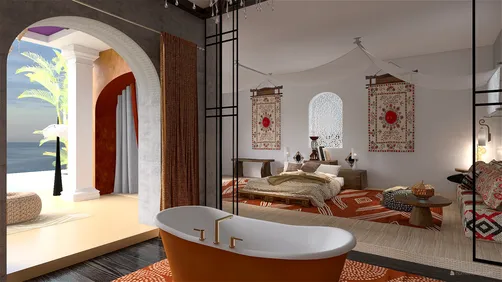
Chambres d'hôtes Quelque Part en Orient by auere val — This bedroom merges warmth and contrast: burnt-orange velvet headboard against cool cerulean tile wainscoting, with hand-beaten brass sconces casting golden halos. Note the subtle texture layering—woven rug, nubby linen drapes, and matte ceramic lamps—all rendered with Homestyler’s Physically Based Rendering (PBR) engine. With one click, users apply the 'Arabic Warm Palette' preset and auto-map artisanal materials to walls, floors, and furniture—achieving museum-grade material fidelity without external software.
FAQ
Q: What defines 'contemporary Arabic style' vs. historical or regional variations?
A: Contemporary Arabic style intentionally bridges eras—it honors foundational elements (geometry, arches, craft-driven materials) but reinterprets them through modern needs: open-plan living, universal accessibility, smart-home integration, and sustainable material choices. Unlike strict historic replication, it prioritizes emotional resonance over literal accuracy—e.g., using laser-cut aluminum instead of carved wood for mashrabiya, or generating algorithmic tile patterns inspired by 12th-century Cordoba manuscripts.
Q: Can I create authentic Arabic interiors in Homestyler without prior cultural knowledge?
A: Yes— Homestyler’s AI-powered Style Assistant recommends culturally appropriate materials, proportions, and layout patterns based on your selected theme (e.g., 'UAE Heritage', 'Moroccan Riad', 'Gulf Modern'). Its curated asset library includes verified Arabic motifs, authentic HDR environments (like g_tropical_beach), and pre-rigged lighting setups—democratizing culturally intelligent design.
Q: Are there specific Homestyler tools optimized for Arabic design challenges?
A: Absolutely. Use the 'Pattern Align' tool for instant geometric tile registration; 'Arch Generator' for parametric arch customization (radius, thickness, reveal); and 'Material Mixer' to blend traditional textures (e.g., tadelakt + brushed brass) with photorealistic PBR response. All top-6 winners in the 2025 Arabic Web Challenge used these tools to achieve award-winning speed and authenticity.


Homestyler offers an easy-to-use online home design tool with stunning 3D renderings, inspiring design projects, and helpful DIY video tutorials. It’s perfect for bringing your interior design ideas to life quickly and effortlessly. Give your home a fresh new look today!
Diseño ahora GRATIS