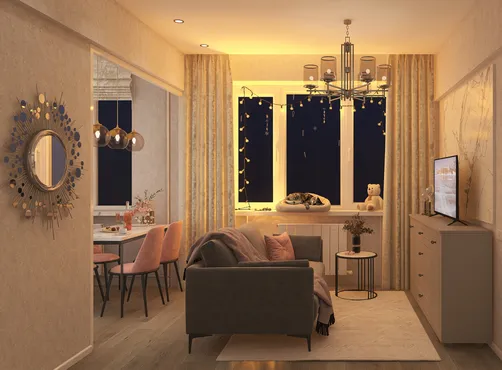
Farewell Year-End Reflection Space Design
The 'Farewell Year-End Reflection Space' is a symbolic, emotionally resonant interior environment that marks the close of a year—not as a static room type, but as a narrative-driven spatial experience. It transcends conventional functional categories (e.g., living room or bedroom) to prioritize atmosphere, memory, transition, and personal symbolism. Inspired by the Homestyler 'Goodbye 2025' design challenge, this scene invites designers to craft spaces that embody reflection (e.g., quiet nooks with tactile materials and warm lighting), celebration (e.g., festive yet intimate gatherings), or hopeful anticipation (e.g., light-filled transitional zones with forward-looking motifs). It emphasizes intentional indoor space planning where layout, materiality, color psychology, and dynamic lighting converge to tell a year-in-review story—making it ideal for portfolio storytelling, AI-assisted concept development, and emotionally intelligent interior design practice.
Design Challenges & Common Pitfalls
Designing a Farewell Year-End Reflection Space presents unique conceptual and technical hurdles: (1) Balancing abstraction with relatability—too literal (e.g., only clocks or calendars) feels clichéd; too abstract risks emotional disconnect. (2) Integrating temporal storytelling without overcrowding—narrative elements (photos, mementos, seasonal decor) must coexist with clean spatial flow and visual hierarchy. (3) Achieving mood consistency across lighting, texture, and color while accommodating diverse cultural interpretations of 'farewell' and 'new beginnings' (e.g., gold warmth vs. winter stillness vs. starlit celebration). These challenges demand nuanced Homestyler design techniques—especially prompt engineering for AI rendering, layered material mapping, and HDR-based lighting simulation to evoke authentic emotional resonance.
🎯 Emotion-First Spatial Narrative
Prioritize feeling over function: begin every design decision with an emotional anchor—'What does closure feel like? What does hope look like in this space?' Use furniture arrangement, focal points (e.g., a floating fireplace or suspended timepiece), and curated objects (vintage books, handwritten notes, dried florals) to build layered, non-verbal storytelling. Avoid decorative clutter; instead, let emptiness and pause—like a single chair facing a window at dusk—speak volumes.

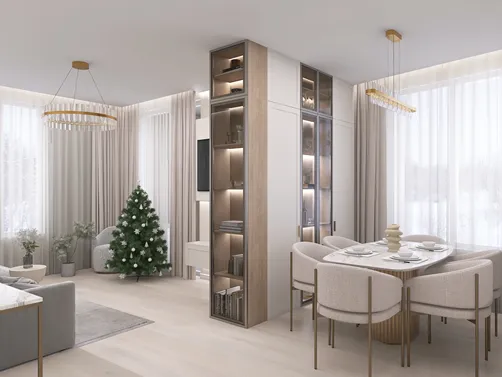
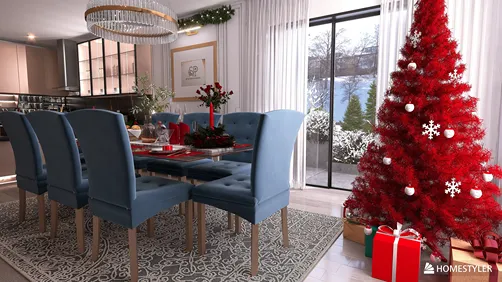
Stefania Pellecchia’s 'La cena di Natale' masterfully applies the Emotion-First Spatial Narrative principle in a Farewell Year-End Reflection Space. Rather than staging a generic dining room, she uses chromatic contrast (blue chairs + red Christmas tree) and soft ambient light to evoke both celebration and nostalgic intimacy—key emotions of year-end reflection. Leveraging Homestyler AI design tools, she precisely controlled HDR settings ('c_winter_snowscape') and sunlight intensity (sunlight:1) to render authentic twilight warmth, transforming a functional dining area into a cinematic moment of communal gratitude and gentle farewell.
Start Free Design Now✨ Intentional Material & Light Layering
Materials and light are not background elements—they’re primary storytellers. Choose textures with emotional weight: rough-hewn stone for grounding memories, brushed brass for golden-hour nostalgia, velvet for quiet luxury, or frosted glass for fragile new beginnings. Pair them with layered lighting: ambient (ceiling), task (reading nook), and accent (spotlight on a keepsake shelf or seasonal tree). Use Homestyler’s HDR presets (e.g., 'moonlit_golf', 'a_winter_snowscape') to simulate time-of-day mood shifts—critical for expressing temporal transition within a single rendered image.

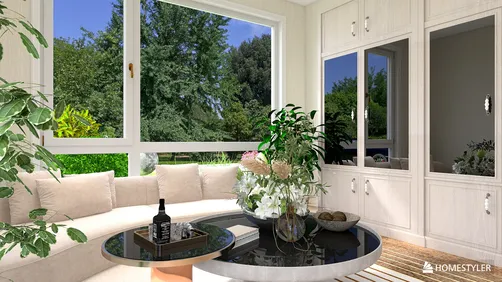
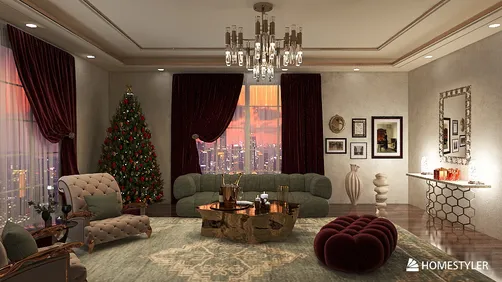
Cecilia Botha’s 'Goodbye 2025' exemplifies Intentional Material & Light Layering in this reflective context. She deploys plush sculptural chairs, warm leather, and bold wall patterns—not for aesthetics alone—but to evoke tactile comfort and rhythmic continuity, mirroring the cadence of a year well-lived. Using Homestyler AI, she selected 'g_hilltop' HDR and sunlight:1 to achieve a luminous, grounded ambiance—proving how strategic tool use elevates material storytelling beyond surface-level decoration into embodied emotional interior space planning.
Begin Your Free Design🧭 Symbolic Layout & Transitional Flow
Layout must guide emotional journey: design circulation paths that mirror reflection → release → renewal. For example, enter through a narrow, textured corridor (past photos or timelines), open into a central gathering zone (fireplace, shared table), then transition toward a light-drenched alcove or window bay (symbolizing future outlook). Use level changes, ceiling height variation, or floor material shifts—even virtually—to reinforce narrative progression. This approach transforms static floor plans into experiential journeys, essential for compelling Homestyler design submissions and client presentations.

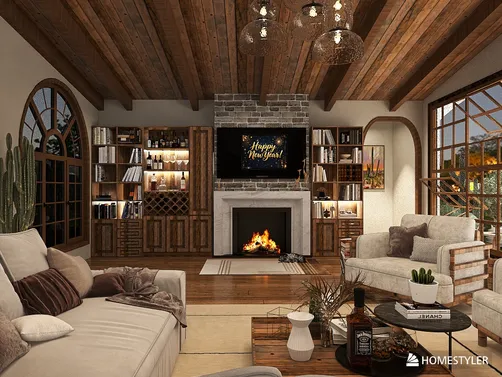
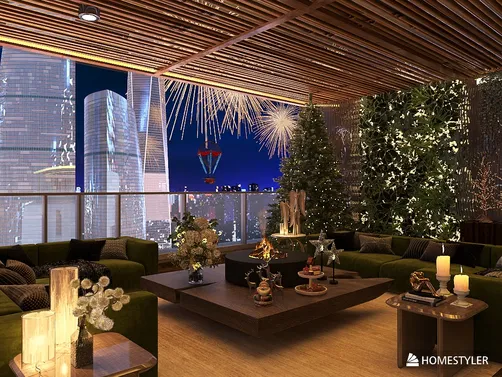
Faye Wade’s 'New Year’s Gathering' brilliantly realizes Symbolic Layout & Transitional Flow in a Farewell Year-End Reflection Space. Though set outdoors, her virtual layout choreographs emotional movement: descending from twilight sky (horizon line) to grounded fire circle (reflection/community), then upward to twinkling overhead lights (aspiration). Using Homestyler’s 'moonlit_golf' HDR and zero sunlight, she simulated celestial transition—showcasing how AI-powered indoor space planning can extend meaningfully into hybrid indoor-outdoor narratives for holistic year-end storytelling.
FAQ
Q: Do I need professional design experience to join the 'Goodbye 2025' challenge?
Not at all. Homestyler AI design tools empower beginners with intuitive drag-and-drop, smart prompts, and one-click style transfers—making expressive interior space planning accessible to everyone.
Q: Can I submit multiple designs for different reflection themes (e.g., 'cozy retreat' and 'celebration space')?
Yes! The challenge encourages thematic exploration. Each submission should reflect a distinct emotional arc of 2025—and Homestyler design techniques like variant rendering and material swaps help rapidly iterate concepts.
Q: How important is realistic lighting in conveying year-end emotion?
Critical. Lighting sets temporal and emotional tone—'shenzhen_night' evokes quiet introspection; 'ljz_night' suggests lively farewell. Mastering HDR presets and sunlight sliders is among the most valuable Homestyler design skills for this challenge.
Q: Are there restrictions on using real personal mementos or photos in my design?
You may symbolically represent them (e.g., framed prints, engraved objects) using Homestyler’s asset library or custom uploads. Focus on emotional authenticity—not literal reproduction—to strengthen your interior space planning narrative.


Homestyler is an easy-to-use online home design platform offering powerful 3D rendering, a vast collection of design projects, and helpful DIY video tutorials. It’s perfect for bringing your interior design ideas to life with creativity and confidence.
Diseño ahora GRATIS