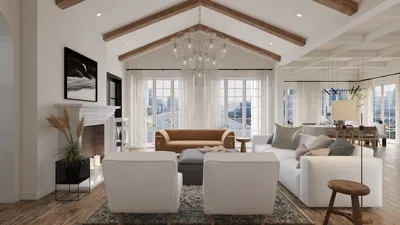


In my early days, I almost compromised a client’s compact pass-through living room by insisting on a sectional sofa. This choice would have obstructed the walkway, creating an uncomfortable ‘furniture tunnel'. I quickly realized that in narrow spaces, every inch matters, and drafting a quick room sketch can spare relationships (and the backsides of sofas).
Compact pass-through living rooms challenge us to think outside the box. They reward clever scaling, layered lighting, and multifunctional furniture. Here, I share five practical layout ideas I've implemented in real projects, along with genuine notes on trade-offs and budgeting tips.
1. Slim sofa paired with a floating side table
I recommend a low-profile, narrow sofa positioned against the wall to keep the main route unobstructed. Complement it with a slim floating side table or wall-mounted shelf across from it, ideal for a lamp and a cup — providing seating without hindering circulation. The benefits include maintaining open sightlines and a breezy ambiance. However, a slim sofa might sacrifice comfort, so opt for denser foam or an upholstered bench for additional coziness.
save pin
2. Employ a runner rug to direct flow
A long runner placed centrally assists in guiding movement and visually lengthens the space. I frequently incorporate two contrasting rugs: one under the seating to stabilize the lounge, and a runner through the pass-through area. This strategy is cost-effective and gives a deliberate feel, though non-slip pads and careful scaling are necessary to ensure the rugs don’t clash.
save pin
3. Low-profile storage solutions and open shelving
Shallow cabinets or a low media console can deliver hidden storage while keeping views unobstructed. Above, open shelving maintains a light atmosphere, but be cautious of visual clutter. I suggest styling using a consistent color palette and a few baskets to conceal smaller items. To reassure a doubtful client about low storage not feeling cramped, a simple 3D mockup became an invaluable tool, showing how effective this idea could be when utilizing a service like Homestyler.
save pin
4. Establish a mini viewpoint with a window seat or bench
If the pass-through features a window or a pleasant view, incorporating a built-in bench with storage can transform the corridor from a simple passageway into a cozy pause area. While it adds seating, built-ins can become costlier — a pre-made bench with lift-up storage serves as a great mid-budget alternative. Illuminate the space beneath the bench or use a slender picture light to give it an intentional touch.
save pin
5. Maintain flow with adaptable partitions
Instead of solid walls, consider using glass panels, open shelving, or folding screens to delineate areas while preserving visibility. For spaces adjacent to kitchens, a slim console with integrated storage or a pocket door can ensure the pass-through remains functional during busy times. Although this requires some custom planning, it offers a fantastic balance between separation and flow — particularly beneficial when designing plans that connect kitchen and lounge areas efficiently using tools like Homestyler.
save pin
FAQ
Q1: What is the ideal width for a pass-through living room walkway? A clear path of at least 36 inches (approximately 91 cm) is suitable for most homes and aligns with basic accessibility guidelines. For two-way traffic or high usage, aim for a width between 42 and 48 inches.
Q2: Can I include a coffee table in a pass-through living room? Certainly, as long as the table is low and narrow, and you maintain a gap of at least 18 to 24 inches between the sofa and the table to avoid obstructing circulation. Nesting tables that can be tucked away when not in use are excellent options.
Q3: What type of lighting is best suited for narrow living rooms? Layered lighting — think recessed or track lights for general illumination, wall sconces to save floor space, and an eye-catching pendant at one end — provides balance in the room. Avoid relying on a single central lamp that may create shadows obstructing pathways.
Q4: Are rugs essential in pass-through spaces? Rugs can help define areas and minimize noise, but choose thin rugs equipped with anti-slip pads to reduce tripping risks. Runners, in particular, are very effective for guiding movement.
Q5: How can I make a narrow living room appear larger? Opt for light colors, low-profile furniture, mirrors, or glossy surfaces. Keeping sightlines clear is also vital; vertical storage draws the eye upward, enhancing the sense of space. Strategic art placement at eye level can further open up perceived dimensions.
Q6: What types of furniture should I avoid? Bulky, high-backed sofas and oversized armchairs can create serious bottlenecks in a pass-through. Instead, look for furniture pieces with exposed legs and slender arms to maintain a sense of visual openness.
Q7: What is the cost of a small pass-through makeover? If you're on a strict budget, rearranging furniture, adding lighting, and including a runner can be done for just a few hundred dollars; however, built-ins or custom sliding panels will be more expensive. I always recommend prioritizing circulation and choosing one meaningful investment — such as bespoke storage or a new sofa — that enhances functionality.
Q8: Where can I find trusted design dimensions? For necessary clear widths and accessibility references, consult the ADA Standards for Accessible Design (https://www.ada.gov/). These guidelines provide accurate measurements crucial for planning circulation in confined spaces.
save pin
Homestyler is your go-to online platform for home design! With its user-friendly design tool, stunning 3D renderings, and a wealth of design projects and DIY video tutorials, you can effortlessly transform your ideas into reality. Start creating your dream space today!
Diseño ahora GRATIS
































